Toronto Summer Sun: More Than Just Vitamin D

In 2016, a group of Swedish researchers published a number that should have rattled the dermatology establishment harder than it did. They had followed 29,518 women for twenty years, sorting them by how much sun they sought out, and they found that the women who actively avoided the sun died at roughly twice the rate of the women who soaked it up. The kicker came when they layered in smoking. Non-smokers who stayed out of the sun had a life expectancy in the same range as smokers who got the most sun. Avoiding daylight, on this data, behaved like a risk factor of a magnitude usually reserved for cigarettes. The MISS cohort, as it is known, is observational and can’t prove that sun-seeking itself did the saving, but the effect was large, it survived adjustment, and it pointed at something the standard public-health script keeps missing.
That script, repeated every spring, goes like this: the sun gives you vitamin D and skin cancer, so cover up, slather on SPF, and take a supplement to make up the difference. It is not wrong about melanoma. But it has quietly collapsed the entire question of sunlight into a single vitamin, and that framing turns out to be a poor model of what light does to a human body. Toronto sits at 43.7 degrees north, which means we spend roughly four months of the year in conditions where the relevant biology barely functions at all. The summer that just started is not a nice-to-have. For this city’s physiology, it is the working season.
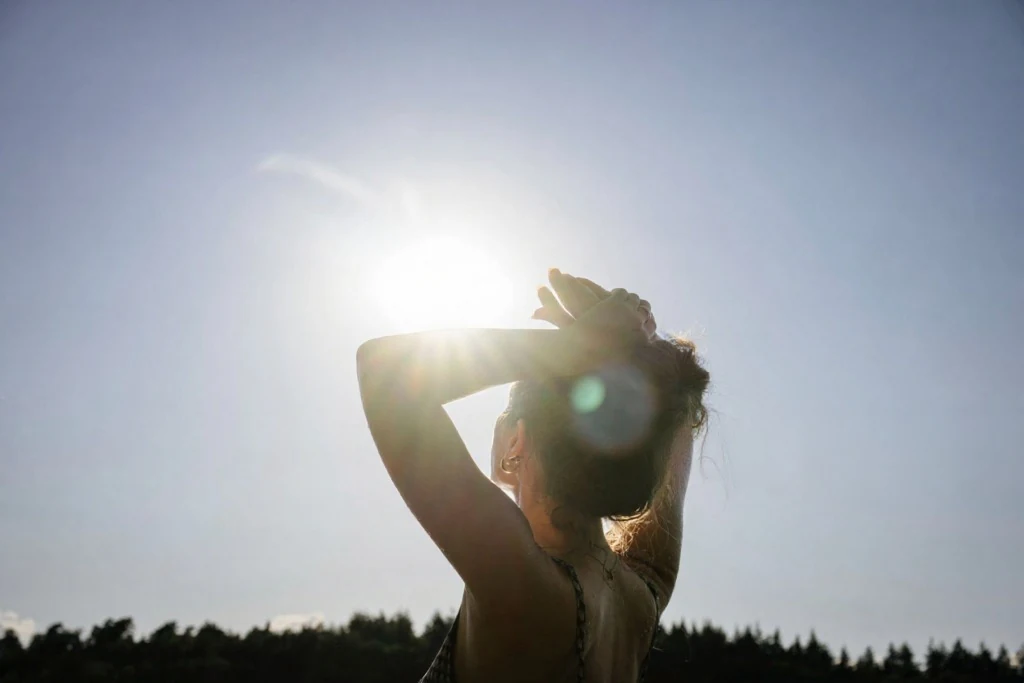
Your skin is a blood-pressure organ
Start with the finding that breaks the vitamin D monopoly cleanly, because it has nothing to do with vitamin D at all. Richard Weller, a dermatologist at the University of Edinburgh, spent years asking an awkward question: if sunlight is purely dangerous, why does blood pressure and cardiovascular death track so tightly with latitude and season, in the same direction, even after you account for temperature? His group’s answer, worked out across a series of human experiments, is that skin stores nitric oxide in a chemically stable form, and ultraviolet light pries it loose.
Nitric oxide relaxes the smooth muscle lining your arteries. When Weller’s team irradiated the skin of healthy volunteers with UVA, blood pressure fell measurably, with circulating nitrite rising as the stored pool was mobilized. An earlier whole-body UVA experiment in Circulation Research recorded systolic and diastolic pressure dropping by around 11 percent at thirty minutes, an effect that lasted up to an hour. The mechanism is independent of the enzyme that normally makes nitric oxide in the body, and critically, it is independent of vitamin D synthesis. The skin is acting as a light-activated reservoir that dumps a vasodilator into the bloodstream on demand. No pill reproduces this. You cannot swallow a sunset.
This reframes a lot of confusing trial data. The big vitamin D supplementation studies, VITAL chief among them, mostly failed to show the cardiovascular and cancer benefits that the observational sunlight literature kept promising. For years that looked like a contradiction. Weller’s reading, echoed in a 2025 expert review in Photochemistry and Photobiological Sciences that pulled together specialists across the field, is that it was never a contradiction. Vitamin D was a marker for sun exposure, not the active ingredient behind the cardiovascular signal. Measuring someone’s vitamin D level tells you how much sun they have been getting, and sun exposure does several useful things at once. Supplement the vitamin in isolation and you get the vitamin in isolation, which is exactly what the trials found.
What the vitamin actually earns
None of this means vitamin D is a bystander, and the supplement story took an interesting turn recently that deserves an honest hearing. VITAL, the 25,871-person randomized trial of 2,000 IU of daily vitamin D3, was largely a disappointment on its headline endpoints. It did not meaningfully cut overall cancer incidence or major cardiovascular events. But a sub-study published in 2025 in the American Journal of Clinical Nutrition looked at something more granular: telomeres, the protective caps on your chromosomes that fray with age. Participants taking vitamin D lost about 140 fewer base pairs of telomere DNA over four years than those on placebo, a difference the authors estimated as roughly three years of cellular aging averted.
So the picture is genuinely mixed, and pretending otherwise would be dishonest. Vitamin D supplementation looks weak for the dramatic outcomes people hoped it would prevent, and intriguing for cellular-level markers whose long-term meaning is still being worked out. The reasonable position for someone in Ontario is that a winter supplement is sensible insurance against frank deficiency, which is common here, while recognizing that the pill is doing a narrower job than sunlight does. Deficiency is real and worth correcting. The error is believing that correcting it captures the whole benefit of getting outside.
Here is where Toronto’s geography stops being trivia. Cutaneous vitamin D synthesis needs UVB photons of a specific energy, and those photons only reach the ground when the sun is high enough. The classic Boston and Edmonton experiments by Webb and Holick showed that human skin makes essentially no previtamin D3 from November through February at Boston’s latitude, with the dead zone stretching October to March in Edmonton. Toronto, at 43.7 degrees north, sits a hair north of Boston. A 2015 CMAJ Open feasibility analysis put it bluntly: for much of the Canadian year, in much of the country, you cannot get enough vitamin D from the sun no matter how long you stand in it, because the UV index simply doesn’t climb high enough. The rule of thumb is that you need a UV index of 3 or more, which in practice means your shadow is shorter than you are tall. From late spring through summer, downtown Toronto clears that bar for hours a day. In January it never gets close.
Skin colour changes the arithmetic, and at this latitude it changes it sharply. Melanin is a natural sunscreen, genuinely protective against UV damage, but it also means darker skin needs considerably more sun to make the same vitamin D. Stack that on a northern city with a long vitamin D winter and the gap shows up plainly in the data. A meta-analysis of dark-skinned migrants in Western countries put pooled deficiency at 77 percent, and in the Canadian Health Measures Survey ethnicity was the single strongest predictor of vitamin D status, with one study of newcomer children in Saskatchewan finding nearly 90 percent had inadequate levels. This isn’t about any group being healthier than another. It’s pigment and latitude, and it’s a plain argument for darker-skinned Torontonians to be deliberate about winter supplementation and about catching the summer sun while it’s here.

The clock you can’t see
The second thing sunlight does has been hiding in plain sight, and the data on it has gotten dramatically better in the last two years. Light is the master input to your circadian system, the roughly 24-hour clock that lives in a cluster of cells in your hypothalamus and is mirrored in nearly every tissue you have. That clock governs far more than when you feel sleepy. It schedules cortisol release in the morning, melatonin at night, insulin sensitivity across the day, body temperature, blood pressure dips, even the timing of immune-cell trafficking. The clock runs slightly off from 24 hours on its own, and it relies on a strong daily light signal to reset. Bright in the day, dark at night. That is the signal the system evolved to read, and most of us now feed it the opposite.
A 2024 study in PNAS made the stakes concrete. Researchers strapped light sensors to 88,905 UK Biobank participants for a week, capturing real personal light exposure rather than relying on questionnaires, then followed them for years. People with the brightest daytime light had progressively lower all-cause mortality. People with the brightest light at night had progressively higher mortality, with those in the top tenth of nighttime light exposure carrying a 21 to 34 percent increased risk of dying from any cause over the follow-up. The relationship held after adjusting for sleep duration, physical activity, and the usual confounders. Day and night were pulling in opposite directions, and the size of the gap between them tracked how disrupted a person’s modeled circadian rhythm was.
A companion analysis from a Harvard-affiliated team, published in JAMA Network Open in late 2025, drilled into the cardiovascular piece using the same kind of objective light data across nearly 89,000 people and more than 13 million hours of recordings. Sleeping in the brightest conditions was associated with a 56 percent higher risk of heart failure and a 47 percent higher risk of heart attack compared with sleeping in darkness. These are observational findings, and people who sleep with lights blazing differ from those who don’t in ways that are hard to fully scrub out. But the mechanism is plausible, the effect sizes are not subtle, and the direction agrees with decades of shift-work research showing that chronically scrambled clocks drive metabolic and cardiovascular harm.
Why morning light is the lever
The practical upshot of the circadian science is more actionable than the sun-exposure debate, because timing matters more than dose. Morning light, hitting the eyes within an hour or two of waking, is the strongest available signal for anchoring the clock to an early, healthy phase. Studies of morning bright-light exposure consistently show it advances the timing of melatonin onset, pulls sleep earlier, and tightens the alignment between behavior and the internal clock. The intensity available outdoors is the point that surprises people. A bright office runs around 500 lux. An overcast Toronto morning outdoors delivers several thousand. A clear summer morning delivers tens of thousands. Window glass cuts the dose substantially, so the light that matters is the light you get with nothing between you and the sky.
This is the cheapest health intervention nobody prescribes. Ten or fifteen minutes outside in the morning, ideally before the worst of the day’s UV index when you are not chasing vitamin D anyway, feeds the circadian system the contrast it needs. It improves sleep onset that night, which feeds back into everything sleep touches: mood, glucose handling, appetite regulation, immune function. Light-timing trials in people with prediabetes and type 2 diabetes are actively testing whether morning light plus dim evenings can improve glycemic control, and the early circadian rationale is sound even where the clinical trials are still reading out. For a desk worker who commutes underground, eats lunch at a screen, and scrolls a bright phone in a dark bedroom, the daily light diet is almost perfectly inverted from what the body wants. Summer is the season when fixing it costs nothing.

The honest caveat, and the better message
The skin cancer warning is not a myth, and a health article that waved it away would be doing the same selective reading it is criticizing. Ultraviolet radiation damages DNA, and sunburn, especially repeated burning in fair skin and especially in childhood, raises melanoma risk in a way the data is clear about. The operative word running through the entire pro-sunlight literature is non-burning. The Swedish cohort that lived longer was not full of women who roasted themselves to leather. The benefit signal sits with regular, moderate, unburnt exposure, and it disappears into harm at the point where skin turns pink. There is no version of this where a blistering July afternoon at the beach is good for you.
Your skin also adapts, which is the physiology behind the old advice to build up sun slowly in spring instead of going from office-pale to a beach day. Regular short, non-burning exposures raise the dose it takes to redden you, the minimal erythema dose, by building melanin and thickening the outer layer of the epidermis. The effect isn’t small. Controlled studies have measured the burn threshold climbing several-fold after a gradual exposure regimen, with the outer skin layer thickening by roughly a third. Worth knowing what doesn’t drive a burn, too: it’s the UV index, not the temperature. You can scorch on a cool, bright day and stay fine on a hot, hazy one, which is exactly why moderation beats either extreme.
What the evidence supports is a more intelligent relationship with light than either extreme offers. Get outside regularly in the months when this latitude actually permits it, in doses short of burning, on skin and on open eyes. Catch the morning light deliberately, because that is the part that resets the clock and asks nothing of your melanocytes. Keep your bedroom genuinely dark, since the nighttime-light data suggests that is doing real cardiovascular and metabolic work. Take a vitamin D supplement through the Toronto winter, when synthesis is off the table, while holding a clear-eyed view of what that pill can and can’t replace. The supplement covers one nutrient. The summer sky, used well, drops your blood pressure through your skin and sets a clock wired into every cell you own.
For more on what a thorough check-up should screen for, see our guide to periodic health visits, what baseline bloodwork tells you in your twenties and thirties, and why sleep deserves a clinical conversation.
Button Health is a new OHIP family practice in downtown Toronto, coming soon and built so reaching your doctor is the easy part.
Join the priority list for first access when we open.
References
-
Avoidance of sun exposure as a risk factor for major causes of death: a competing risk analysis of the Melanoma in Southern Sweden (MISS) cohort. Journal of Internal Medicine, 2016. DOI: 10.1111/joim.12496 onlinelibrary.wiley.com/doi/10.1111/joim.12496
-
UVA Irradiation of Human Skin Vasodilates Arterial Vasculature and Lowers Blood Pressure Independently of Nitric Oxide Synthase. Journal of Investigative Dermatology, 2014. DOI: 10.1038/jid.2014.27 jidonline.org/article/S0022-202X(15)36878-0/fulltext
-
Whole Body UVA Irradiation Lowers Systemic Blood Pressure by Release of Nitric Oxide From Intracutaneous Photolabile Nitric Oxide Derivates. Circulation Research, 2009. DOI: 10.1161/CIRCRESAHA.109.207019 ahajournals.org/doi/abs/10.1161/CIRCRESAHA.109.207019
-
Beneficial health effects of ultraviolet radiation: expert review and conference report (Riedmann et al.). Photochemical & Photobiological Sciences, 2025; 24(6):867-893. link.springer.com/article/10.1007/s43630-025-00709-8
-
Vitamin D3 and marine omega-3 fatty acids supplementation and leukocyte telomere length: 4-year findings from the VITAL randomized controlled trial. American Journal of Clinical Nutrition, 2025. DOI: 10.1016/j.ajcnut.2025.04.022 ajcn.nutrition.org/article/S0002-9165(25)00255-2/abstract
-
Influence of season and latitude on the cutaneous synthesis of vitamin D3: exposure to winter sunlight in Boston and Edmonton will not promote vitamin D3 synthesis in human skin (Webb, Kline, Holick). Journal of Clinical Endocrinology & Metabolism, 1988. pubmed.ncbi.nlm.nih.gov/2839537
-
Assessment of the feasibility of using sunlight exposure to obtain the recommended level of vitamin D in Canada. CMAJ Open, 2015; 3(3):E258. cmajopen.ca/content/3/3/E258
-
Brighter nights and darker days predict higher mortality risk: a prospective analysis of personal light exposure in >88,000 individuals (Windred et al.). PNAS, 2024. DOI: 10.1073/pnas.2405924121 pnas.org/doi/10.1073/pnas.2405924121
-
Light Exposure at Night and Cardiovascular Disease Incidence (UK Biobank). JAMA Network Open, 2025. jamanetwork.com/journals/jamanetworkopen/fullarticle/2840489
-
The role of sunlight in sleep regulation: analysis of morning, evening and late exposure. PMC, 2025. PMC12502225 pmc.ncbi.nlm.nih.gov/articles/PMC12502225/
-
The prevalence of vitamin D deficiency among dark-skinned populations according to their stage of migration and region of birth: a meta-analysis. Nutrition, 2016. pubmed.ncbi.nlm.nih.gov/26643747
-
Melanin levels in relation to vitamin D among first-generation immigrants from different ethnic groups and origins: a comparative national Canadian cross-sectional study (Canadian Health Measures Survey). Frontiers in Medicine, 2022. frontiersin.org/journals/medicine/articles/10.3389/fmed.2022.992554/full
-
UV adaptation: pigmentation and protection against overexposure (de Gruijl). Experimental Dermatology, 2017. DOI: 10.1111/exd.13332 onlinelibrary.wiley.com/doi/full/10.1111/exd.13332
-
Effect of repeated low-dose UVR exposure on skin inflammation threshold, skin biomarkers, and vitamin D in healthy adults. Journal of Investigative Dermatology, 2025. sciencedirect.com/science/article/pii/S0022202X2500106X