I Read 110,722 Toronto Clinic Reviews. The Problem Isn't the Medicine.

A couple of years ago I had a hypothesis: that health outcomes improve when you fix the environment around the medicine, not just the medicine itself. I tested it back home in Alberta. Over 750 people validated the idea, enough that some of them tried to pay me for it before it existed.
Then a pandemic happened, and a stretch of work with dentists who wanted real insight into their practices and their patients’ journeys, and I ended up here, building Button Health. I’m building it because I can see the same break from both sides of the desk, the patient’s and the physician’s.
My whole career, going back to before the turn of the century, has been organizational change: taking things that have stopped working for the people who depend on them and making them work again. So when family medicine in this city started visibly falling apart, I did the thing I always do. I went looking for the actual problem instead of the assumed one.
I read the reviews, all of them
I did what you’d do, except I wrote code to pull every review instead of skimming a few. When I finished I had just over 260,000 reviews across roughly 2,300 clinics, Steeles to the lake, Etobicoke to Scarborough. Then I stripped out the walk-ins, because walk-in volume drags the average down and I wanted to see family medicine on its own. That left 1,316 clinics and 110,722 reviews. Real Toronto patients, real visits.
It confirmed what everyone I know had already told me. So I started with the angry ones.
One in three is a one-star
33,036 of those reviews, almost exactly one in three, are a single star. The average Toronto family clinic limps in at 3.85: propped up by five-star reviews, dragged down by thirty thousand people angry enough to stop their day and type it out.
The one-stars were brutal, detailed, and relentlessly repetitive. So I read them, tagged every one by what set it off, and waited to find out how many were about a doctor getting the medicine wrong.
What Toronto is actually furious about
Here is every bad review sorted by what it complained about. Watch what happens between the fourth row and the fifth.
| What patients complain about | Share of bad reviews | A real Toronto review |
|---|---|---|
| Can’t get an appointment | ~35% | “Not accepting new patients because the doctor has more than enough patients.” |
| Can’t reach the office | ~33% | “Called 8 times. On hold 5 to 15 minutes each time. When someone finally picks up, they hang up.” |
| The wait | ~29% | “Two hours in the waiting room, then 15 minutes in the office, for a 2-minute checkup.” |
| The front desk | ~29% | “I had to switch family doctors because the front staff are the problem, not the practitioners.” |
| Felt unheard by the doctor | ~8% | “Interrupted my symptom explanation three times.” |
| The actual medicine | ~7% | “Misdiagnosed and prescribed the wrong meds for the wrong issue.” |
Percentages overlap, since one review can name more than one thing.
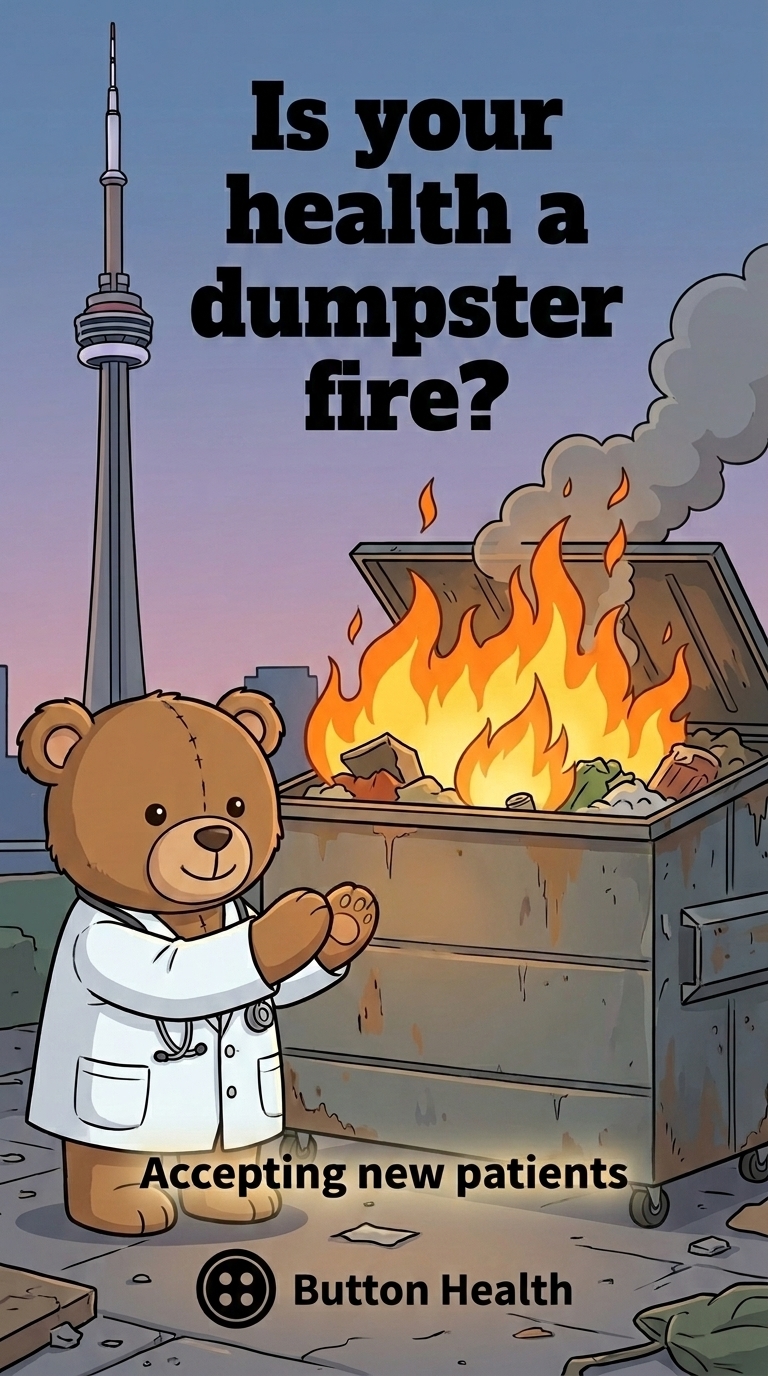
That cliff between the fourth row and the fifth is the entire story. The thing that makes a Toronto patient want to torch a clinic is four times more likely to be a phone nobody answers or a rude front desk than a doctor who got it wrong. The medicine is mostly fine. Everything wrapped around it is on fire.
This isn’t on the doctors
It would be easy to read thirty thousand one-stars and decide Toronto is full of bad family doctors. That’s wrong, and worth saying flat out.
The physician billing OHIP is stuck in the same broken machine as the patient. A typical Toronto family doctor burns about 19 hours a week on paperwork. Roughly 2.5 million Ontarians have no family doctor at all, and the College of Family Physicians expects that to clear 4 million by the end of 2026. The ones who do have a doctor are fighting for a ten-minute slot on an overbooked calendar, guarded by a front desk answering phones, checking people in, faxing prescriptions, filling forms, fielding questions, and sometimes taking vitals, week after week, dealing with people who are rarely at their best.
The reviews don’t change when there’s a brilliant clinician in the building. The phone still rings out. The visit still feels rushed. The follow-up call still never comes. Toronto is expensive, labour is expensive, rent is expensive, and there are too few doctors doing too much for too many people. Everything is stretched thin.
Why I’m the one writing this
I’m not a clinician, and I’m not a corporation. I have no outside investors, no board chasing optics and shareholder value, no interest in wrecking Canadian healthcare. What I have is twenty-five years of fixing organizations across very different industries, the unglamorous work of taking operations that stopped serving the people who depend on them and making them function again. And I have a personal reason. My parents died three years apart, both of cancer, both diagnosed at a stage too late to do anything but manage the end. That changes how you read a system. I came out of it with one promise to myself: be active in my own health, and if I could, deliver the kind of care I wanted for them.
The thing no one at an OHIP clinic will say to your face
OHIP family medicine is the floor of the system. I mean that precisely, not as an insult. It is publicly funded, volume-based care designed to deliver a baseline to as many people as possible. It is not built for prevention, and it is not built for depth. A ten-minute slot, billed the way the province pays for it, can’t be the place where someone catches the slow-moving thing in you years before it has a name.
So here’s the most useful thing I can tell you, and most clinics never will: the highest-leverage move available to you is to become the most informed, most engaged person about your own body in any room you walk into. Become high-agency about your health.1 In a lot of cases you will, honestly, care more than a stranger working through a full waiting room ever can, and that’s not cynicism, it’s the math of the system you’re standing in. We intend to be a very good front door. But the best floor in the world is still a floor, and no OHIP-funded clinic is a replacement for you paying attention to you.
So I am building the best floor in the city
I didn’t guess at what patients want. I took the four loudest things in the data and am making each one somebody’s job, building the operations layer most clinics don’t do, or don’t do well.
| What you hear everywhere else | What we’re building |
|---|---|
| “Nobody answers the phone.” | Most booking happens online, so the phone isn’t the only door. The front desk is a designed role with owned responsibilities, not one person drowning in five jobs at once. |
| “I never heard back.” | Follow-up is a system, not a favour someone happens to remember. Automated texts and a patient portal, so you can see where things stand instead of waiting for a call that never comes. |
| “The doctor had no idea why I was there.” | You tell us what’s wrong when you book. So the doctor knows before they walk into the exam room. |
| “A different stranger every time.” | Same care team every visit. No walk-in roulette, no rotating cast. |
The operational weight sits on the clinic, where it belongs, not on you. If you want the long version of how Ontario’s system works and where it fails, I wrote a full guide to using the Canadian healthcare system.
A different kind of clinic
Button Health is a new OHIP family practice at Bay and College in downtown Toronto, coming soon and being built so reaching your doctor is the easy part.
That promise to myself turned into three practices, each with a different focus: Button Health for accessible OHIP family medicine across the GTA, Plunge Health for enhanced preventative family care, and The Mas Clinic for men’s enhanced cardiovascular health. We’re actively building the waitlist now at the new Bay and College location- so if you see my team on the street, say hi or if you see one of our ads, sign up.
Family medicine needs a new kind of clinic. Thirty thousand one-star reviews are sitting in plain sight to prove it.
Join the priority list for first access when we open.
I analyzed public Google reviews for clinics across the City of Toronto to understand what patients experience: 110,722 medical clinic (non-walk-in) reviews across 1,316 family-medicine practices, of which 33,036 were a single star. Theme percentages are the share of negative reviews mentioning each issue and overlap, since one review can raise several. I have not named any individual clinic, and every quote above is reproduced without the reviewer’s name.
References
- OCFP Statement: Administrative Burden. Ontario College of Family Physicians, April 2024. (Family physicians spend, on average, 19 hours a week on administrative tasks.) ontariofamilyphysicians.ca/news/ocfp-statement-administrative-burden/
- Addressing physicians’ administrative burden: the invisible crisis in family medicine. Canadian Medical Association, August 2023. cma.ca/latest-stories/addressing-physicians-administrative-burden-invisible-crisis-family-medicine
- New Data Shows There Are Now 2.5 Million Ontarians Without a Family Doctor. Ontario College of Family Physicians, 2024. ontariofamilyphysicians.ca/news/new-data-shows-there-are-now-2-5-million-ontarians-without-a-family-doctor/
- More Than Four Million Ontarians Will Be Without a Family Doctor by 2026. Ontario College of Family Physicians, 2023. ontariofamilyphysicians.ca/news/more-than-four-million-ontarians-will-be-without-a-family-doctor-by-2026/
- Family Physician Retirement Projections (INSPIRE-PHC modelling backgrounder). Ontario College of Family Physicians / INSPIRE-Primary Health Care, 2023. ontariofamilyphysicians.ca/wp-content/uploads/2023/11/backgrounder_retirement.pdf
- Roughly 4.4 million people in Ontario won’t have a family doctor in 2026, data projects. CBC News, 2023. cbc.ca/news/canada/hamilton/family-doctor-shortage-projection-1.7023430
- One in four Ontarians may be without a family doctor by 2026, analysis says. The Globe and Mail, 2023. theglobeandmail.com/canada/article-one-in-four-ontarians-may-be-without-a-family-doctor-by-2026-analysis/
- Family Medicine in Crisis. Dialogue, College of Physicians and Surgeons of Ontario. dialogue.cpso.on.ca/articles/family-medicine-in-crisis
- Analysis of public Google reviews for family-medicine clinics across the City of Toronto (110,722 reviews across 1,316 practices; 33,036 one-star). Button Health, 2026.
Footnotes
-
High agency is the capacity to take initiative, take ownership of your outcomes, and act on what you can control rather than waiting on the system or blaming it. For your health it means learning how your own body works, reading up on your conditions and results, and coming in informed, so you are an active participant in your care instead of a passive one. ↩