Toronto Keeps Having the World's Worst Air. Here's What Wildfire Smoke Does to You
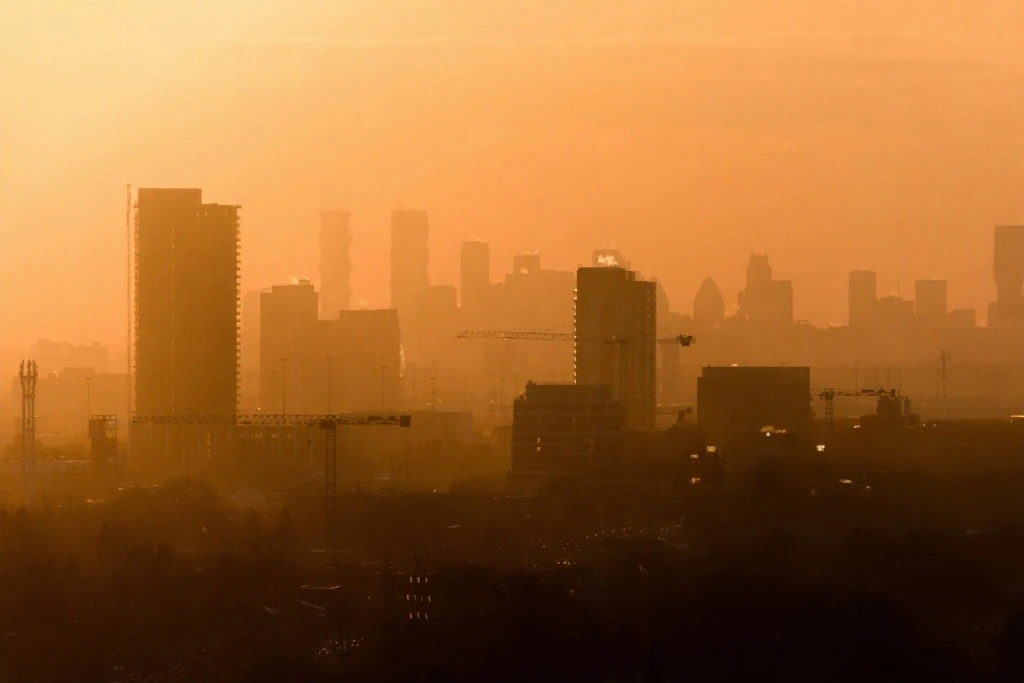
On the morning of July 15, 2026, a Swiss air quality firm ranked Toronto as having the worst air of any major city on Earth, ahead of Delhi and Kinshasa. The Air Quality Health Index across the GTA, from Mississauga to downtown Toronto to Oshawa, sat at 10 or higher, the top of a scale that only labels the risk “very high.” The sky turned a flat orange, the skyline blurred, and Environment Canada told people to reschedule or cancel anything happening outdoors. It stayed that way for three days, driven by smoke drifting south from forest fires in northwestern Ontario, with only brief afternoon reprieves before the haze rolled back in each evening.
The part worth sitting with is that this is no longer a freak event. Toronto has now had a significant smoke episode every summer since 2023, and each time the public conversation treats it as a strange one-off. It is not. Wildfire smoke has become a recurring feature of the Ontario summer, the same way a heat wave is, and the health effects are better understood now than they were even two years ago. Most of that new understanding is not reassuring.
Why Smoke Is Not Just “Bad Air”
The number that matters in wildfire smoke is PM2.5, particulate matter smaller than 2.5 micrometres across. For scale, that is roughly one-thirtieth the width of a human hair. Particles that small behave differently from ordinary dust. They slip past the nose and throat, travel deep into the smallest airways of the lungs, and a fraction of them cross into the bloodstream directly. Once they are circulating, they are no longer only a lung problem. They reach the heart and blood vessels, which is why the health data on smoke is dominated by cardiovascular events, not just coughing.
The AQHI you see on your weather app is a 1-to-10+ scale built largely around this pollutant along with ozone and nitrogen dioxide. At 1 to 3 the risk is low, at 4 to 6 it is moderate, at 7 to 10 it is high, and above 10 it is very high. During the July episode, downtown Toronto spent stretches of the day above 10. That reading is not an abstraction. It is a direct estimate of how much the air is loading your lungs and bloodstream that hour.
There is a further wrinkle that is easy to miss. Not all PM2.5 is equal. A growing body of research finds that the fine particles in wildfire smoke are more harmful, particle for particle, than the fine particles in ordinary city traffic pollution. Smoke PM2.5 is richer in carbonaceous compounds that provoke more oxidative stress and inflammation in human tissue. In practical terms, a smoke day at a given AQHI reading may be doing more damage than an equivalent reading on a smoggy but smoke-free August afternoon. The reflex to treat wildfire haze as “just pollution, we get that every summer” understates the risk.
What It Does in the First Few Days
Most healthy people notice the acute effects within hours. Scratchy throat, stinging eyes, a dry cough, a headache, a heaviness in the chest during a walk that normally feels easy. These are irritation and inflammation, and for a young healthy adult they usually fade once the air clears. They are still a signal that the exposure is real and worth limiting.
For people with asthma or chronic obstructive pulmonary disease, the first few days are where the danger concentrates. Smoke episodes reliably drive spikes in emergency department visits for asthma attacks and COPD flares, and the surge tracks the smoke almost day for day. Someone whose asthma is normally well controlled can find their rescue inhaler suddenly doing less than it should. The cardiovascular side is quieter but more serious: emergency visits for heart attacks, strokes, and irregular heart rhythms also climb during and just after heavy smoke, because the inflammation and the fine particles put measurable strain on the heart and blood vessels. The people who end up in trouble are often not the ones who feel the worst that day. They are the ones with an underlying condition that the smoke tips over.
The Part That Doesn’t Clear When the Sky Does
The most important recent finding is about time. For years the working assumption was that smoke was a nuisance while it lasted and a non-issue once the wind changed. That assumption is wrong.
A 2025 study from researchers at Harvard, the first to look carefully at the medium-term effects of smoke, found that the elevated risk of cardiovascular and respiratory problems can persist for months after a wildfire ends, not days. The fine particles set off inflammation that keeps running well after the visible haze is gone. Separate long-term work, including a large analysis across the contiguous United States published in PNAS, links sustained exposure to wildfire smoke PM2.5 with a higher risk of death, with cardiovascular disease accounting for the largest share. A causal modelling study in Science Advances reached the same broad conclusion using a different method. The science is still young and the long-term estimates carry real uncertainty, but the direction is consistent across independent teams: repeated smoke seasons are not a series of harmless bad-air weekends. They accumulate.
This reframes what a smoke episode actually is. It is not only a three-day inconvenience to wait out on the couch. For someone with a heart or lung condition, it is a cardiovascular stress test that keeps exerting pressure for weeks, and one that now arrives every summer.
Who Should Be Most Careful
The higher-risk groups are consistent across every health advisory: people with asthma, COPD, or other chronic lung disease; people with heart disease or high blood pressure; pregnant people; infants and young children, whose airways are small and still developing; adults over 65; and anyone who works or exercises outdoors and cannot easily stop.
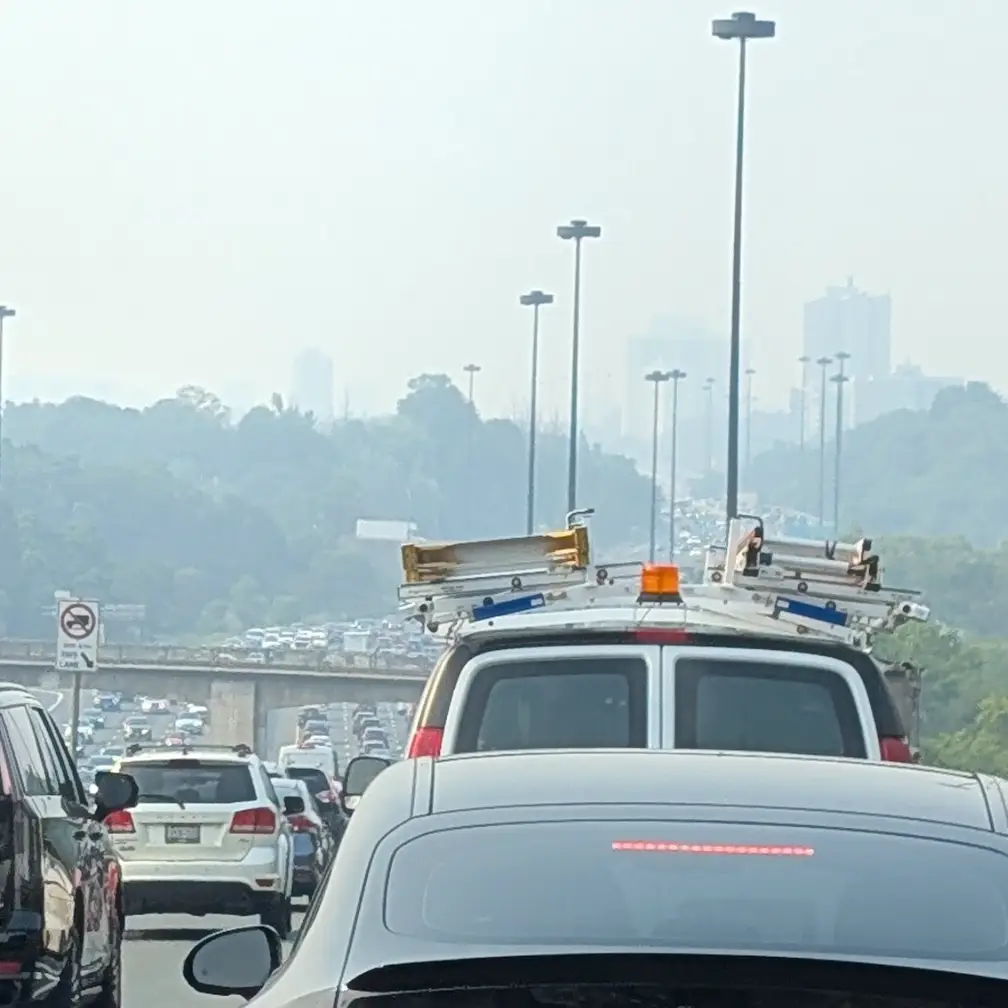
Downtown Toronto adds its own wrinkles. A lot of the core lives in older high-rise apartments without central air or real filtration, where opening a window for relief on a hot night pulls the smoke straight indoors. The commute is heavy on cycling and walking, which means deep, fast breathing right at street level during exactly the hours the air is worst. Patios and outdoor gyms and run clubs keep operating because the sky looks weird but the city keeps moving. If you belong to one of the higher-risk groups and you live or work in the core, the default of pushing through is the wrong instinct on a 10-plus day.
What Actually Helps
The interventions that work are unglamorous and effective.
Watch the AQHI, not the sky. Colour and smell are poor guides to how much fine particulate is actually in the air. At 7 or above, higher-risk people should cut back or reschedule strenuous outdoor activity. At 10 or above, that applies to everyone, and higher-risk people should stay indoors as much as they can.
If you must be outside for a stretch on a heavy day, a properly fitted N95 or KN95 respirator meaningfully reduces how much PM2.5 you breathe in. A cloth mask or a surgical mask does very little against particles this small, because the fit and the filtration are both wrong for the job. The mask only works if it seals to your face.
Indoors, keep windows and doors closed during the worst of it, run air conditioning on recirculate rather than drawing in outside air, and if you can, run a HEPA air purifier in the room where you spend the most time. A well-sealed apartment with a decent purifier can hold indoor particulate far below the street reading. If your building has none of that, a public library, mall, or community centre with real filtration is a legitimate refuge on the worst afternoons.
If you have asthma or COPD, this is the season to make sure your rescue medication is filled and current and that you know your action plan before the smoke arrives, not while you are struggling to breathe through it. When the air is this bad, a virtual appointment is often the right way to reach a doctor without leaving a filtered room.
When to Call a Doctor, Not Wait It Out
Mild throat and eye irritation that eases once you are inside is expected and does not need medical attention. What does: shortness of breath that does not settle with rest, chest tightness or pain, wheezing that your usual inhaler is not controlling, a rapid or irregular heartbeat, dizziness, or a cough that is getting worse rather than better over several days. For anyone with heart or lung disease, new or escalating symptoms during a smoke episode deserve a same-day call rather than a wait-and-see. Chest pain, severe breathlessness, or fainting are reasons to seek emergency care, not to book an appointment.
There is a longer-game point here too, and it is the one that gets lost in the annual scramble for masks. Smoke season is now a predictable part of the Ontario calendar. That makes it something to manage ahead of time rather than react to. For someone with asthma or COPD, that means a controller medication regimen that is actually optimized before June, a written action plan, and a doctor who checks in after a bad stretch to see whether the flare left a mark, rather than only meeting you in the middle of a crisis. That kind of proactive, continuous care is exactly what a family practice is built to provide and exactly what walk-in and pop-up clinics cannot, because they never see the same patient twice or track how this July compared to last.
If you want to understand how the healthcare system around you is supposed to work, or what routine care looks like when you actually have a doctor to call, our guide to the Canadian system and our piece on what a periodic health visit covers are good places to start.
Button Health is a new OHIP family practice in downtown Toronto, coming soon and built so reaching your doctor is the easy part, including the summers when the air turns against you.
Join the priority list for first access when we open.
References
-
Toronto now has world’s second-worst air quality as wildfire smoke lingers. TorontoToday, July 2026. torontotoday.ca/local/environment-climate/toronto-second-worst-air-quality-wildfire-smoke-12554576
-
Toronto’s smoky conditions continue for a third day and may persist into the weekend, Environment Canada says. CP24, July 17, 2026. cp24.com/local/toronto/2026/07/17/torontos-smoky-conditions-continue-for-the-third-day-in-a-row-and-may-persist-into-the-weekend-environment-canada-says/
-
Ontario wildfires trigger air quality warnings for Toronto, southern regions. The Globe and Mail, July 2026. theglobeandmail.com/canada/article-ontario-wildfires-smoke-air-quality-warnings/
-
Cardiorespiratory effects of wildfire smoke particles can persist for months, even after a fire has ended. Harvard T.H. Chan School of Public Health, 2025. hsph.harvard.edu/news/cardiorespiratory-effects-of-wildfire-smoke-particles-can-persist-for-months-even-after-a-fire-has-ended/
-
Long-term exposure to wildland fire smoke PM2.5 and mortality in the contiguous United States. PNAS, 2024. DOI: 10.1073/pnas.2403960121 pnas.org/doi/10.1073/pnas.2403960121
-
Wildfire smoke PM2.5 and mortality rate in the contiguous United States: a causal modeling study. Science Advances, 2025. DOI: 10.1126/sciadv.adw5890 science.org/doi/10.1126/sciadv.adw5890
-
Chronic effects of wildfire smoke and criteria air pollutants on cardiovascular hospitalization rates in the contiguous US. Science of the Total Environment, 2025. sciencedirect.com/science/article/abs/pii/S0013935125017724
-
Air Quality Health Index (AQHI) categories and recommended actions. Environment and Climate Change Canada. weather.gc.ca/airquality/pages/index_e.html